
Scottish Painted Dial Longcase Clocks
Scottish painted dial longcase clocks combine practical clockmaking, fine cabinet work and decorative art in one impressive object. With their tall, beautifully proportioned cases and richly illustrated dials, these clocks have a presence that few other antiques can match.
Each example offers a glimpse into the place and period in which it was made. The clockmaker’s name, the town recorded on the dial, the shape of the case and even the subject of the painted decoration may all help reveal its story.
For collectors, painted dial clocks represent a particularly colourful chapter in the history of Scottish clockmaking. For those furnishing a traditional or contemporary home, they offer the opportunity to own an antique that remains both useful and visually striking.
The arrival of the painted clock dial
Painted—or “white”—dials began to appear on British longcase clocks during the later eighteenth century. They gradually became a popular alternative to the engraved brass dials associated with earlier clocks.
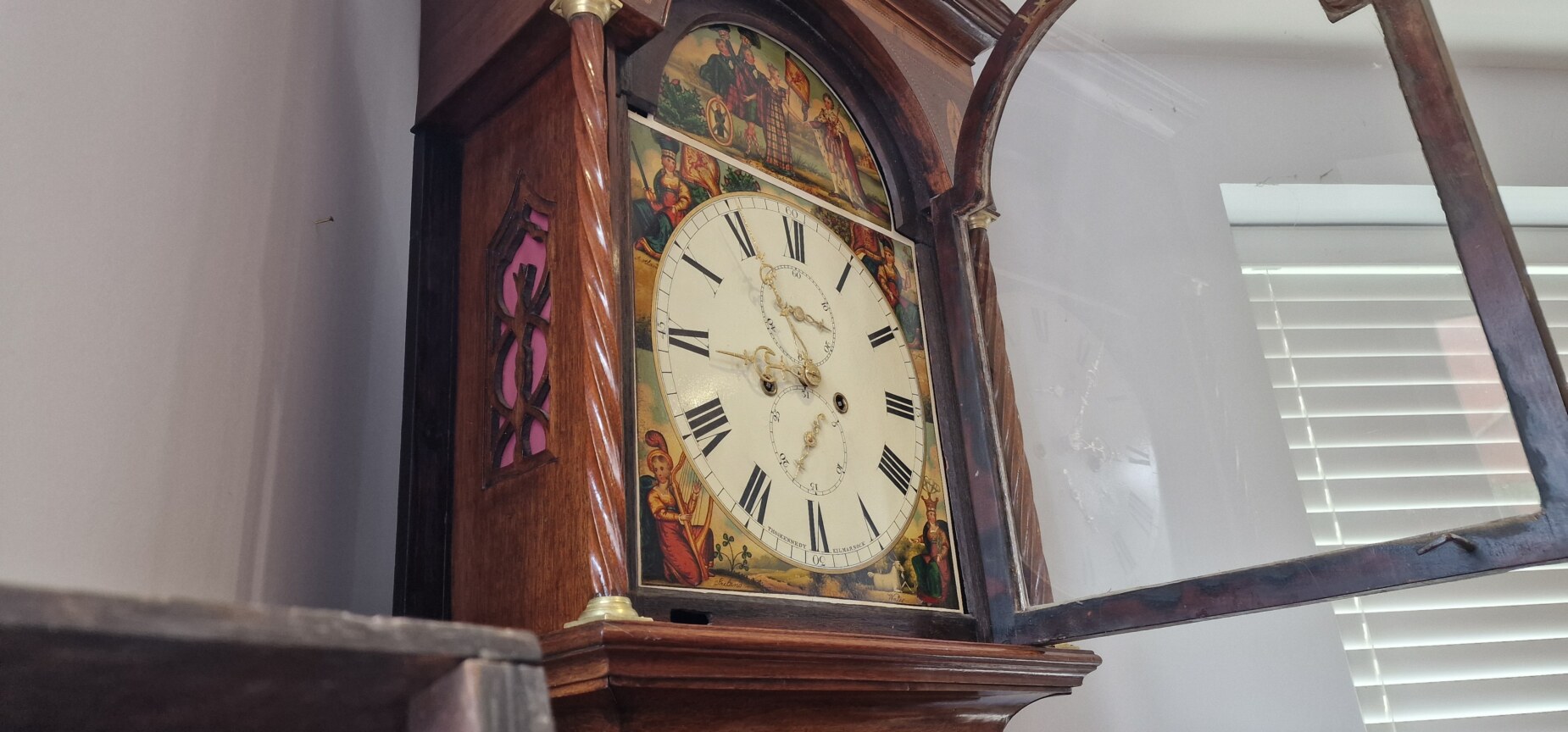
The new dials were usually made from sheet iron and finished with a light-coloured painted surface. This provided a clear background for the numerals while also giving decorative painters considerably more freedom.
Early painted dials often retained the visual arrangement of their brass predecessors. Decorative corner pieces were represented by painted flowers, foliage or geometric designs, while the hours and minutes remained prominently displayed around the chapter ring.
As the nineteenth century progressed, the decoration became more ambitious. The corners and arch of the dial were transformed into miniature canvases filled with landscapes, portraits, allegorical subjects and scenes from history.
Scottish clockmakers embraced this fashion enthusiastically, producing clocks with a character that was often quite distinct from contemporary English examples.
What makes a Scottish painted dial distinctive?
There is no single feature that proves a painted dial clock is Scottish. Identification usually depends upon a combination of details.
The most obvious clue is the signature. Many dials carry the name of a clockmaker or retailer together with the town in which the business operated. Edinburgh, Glasgow, Perth, Aberdeen, Dundee and numerous smaller Scottish towns supported clockmakers during the Georgian and Victorian periods.
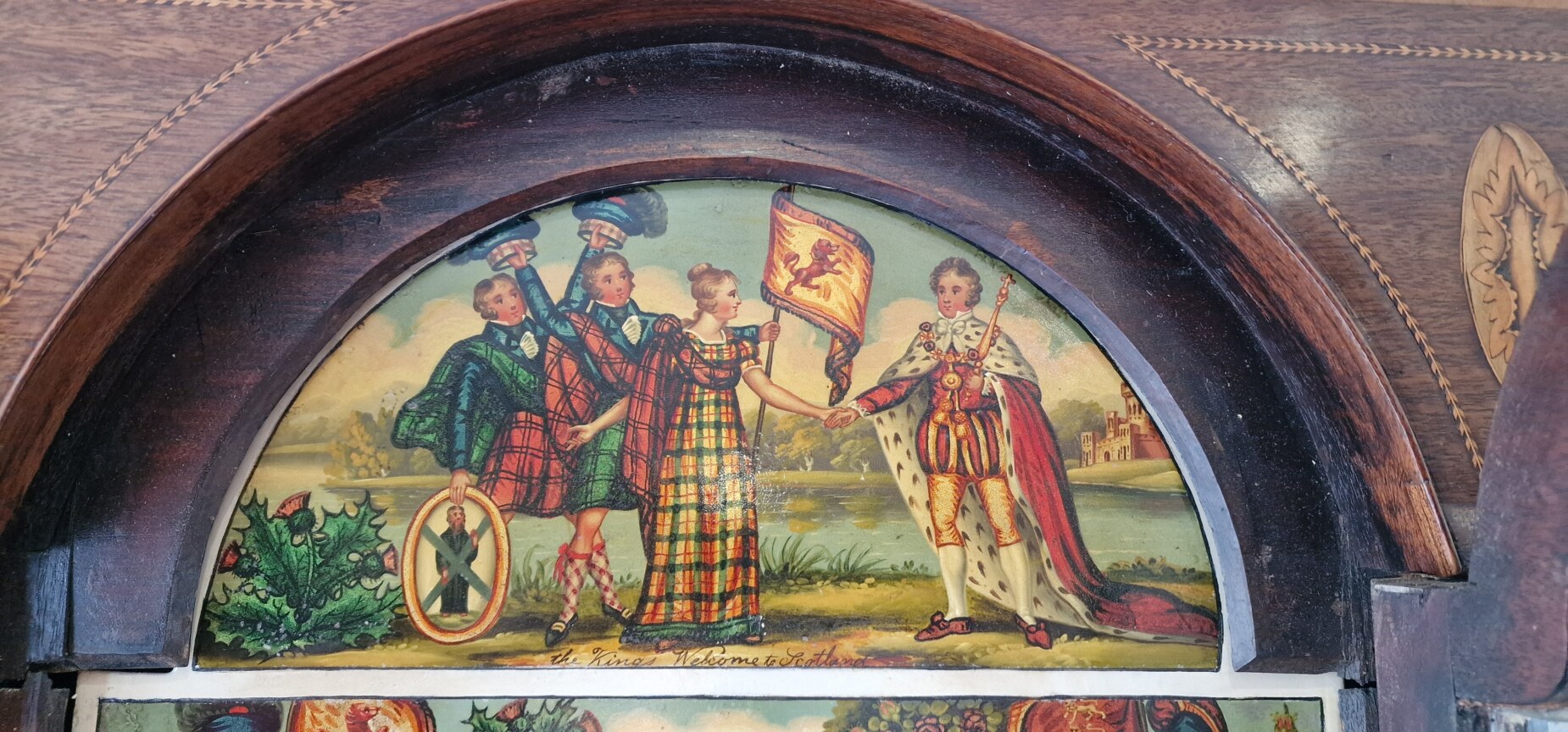
The style of the case can also provide useful evidence. Scottish longcase clocks were produced in several regional forms, ranging from restrained country clocks in oak to grand mahogany examples with elegant veneers, inlay and swan-neck pediments.
Dial proportions, numerals, hands and decorative subjects may offer further clues. These features must be considered together rather than used as a rigid dating system, because fashions continued for different lengths of time in different areas.
The construction of the movement is equally important. A careful inspection may reveal whether the dial, movement and case were intended to be together or were assembled from unrelated components at a later date.
Decoration with a story to tell
The painted dial is naturally the focal point of these clocks. Some examples are delicately decorated with flowers, fruit, shells or birds. Others have figures painted in the four corners, often united by a common theme.
Representations of the four seasons were especially well suited to a clock dial. Spring, summer, autumn and winter could be placed in the four spandrels, creating a pleasing connection between the passage of the year and the measurement of time.
Historical and literary subjects also appear. Scottish history supplied painters with a wealth of dramatic material, including monarchs, military figures and celebrated national events. Biblical stories, rural scenes and allegorical subjects such as peace, plenty, justice or commerce were also used.
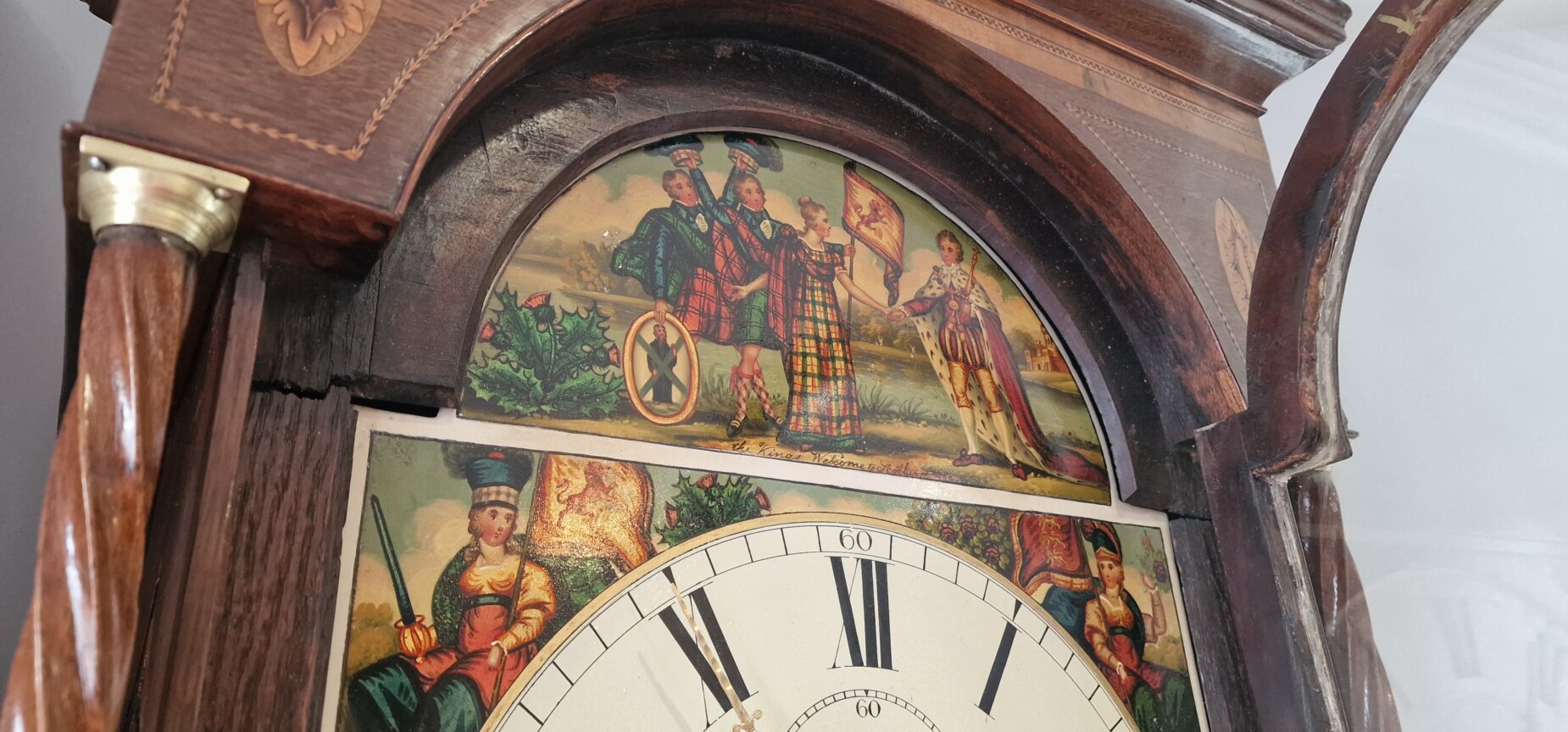
The arched section above the main dial offered room for a larger composition. On some clocks it contains a country house, a harbour scene or a domestic interior. On others it accommodates a moonphase display or an automaton.
These painted scenes turn an otherwise functional instrument into an individual work of decorative art.
Moonphase and automaton dials
A moonphase is among the most desirable features found on a painted dial longcase clock. A rotating disc in the arch displays the changing phases of the moon as the clock runs.
Although the indication had a practical purpose, it also gave the dial painter an opportunity to create a memorable design. Moons with expressive faces might appear against deep blue skies, accompanied by stars, sailing ships or pastoral landscapes.
Automaton dials introduce movement of a different kind. A ship may rock upon painted waves, a figure may move with the action of the clock or a scene may change as the mechanism operates.
The charm of these features lies in the combination of mechanics and imagination. They also demand specialist attention, as the additional components must be correctly adjusted without placing unnecessary strain on the clock’s movement.
Thirty-hour and eight-day movements
Scottish painted dial longcase clocks are commonly encountered with either thirty-hour or eight-day movements.
A thirty-hour clock normally requires winding every day. Many are wound by pulling a chain or cord inside the case. These movements can be comparatively simple, but simplicity should not be mistaken for insignificance. A good provincial thirty-hour clock may be full of character and historical interest.
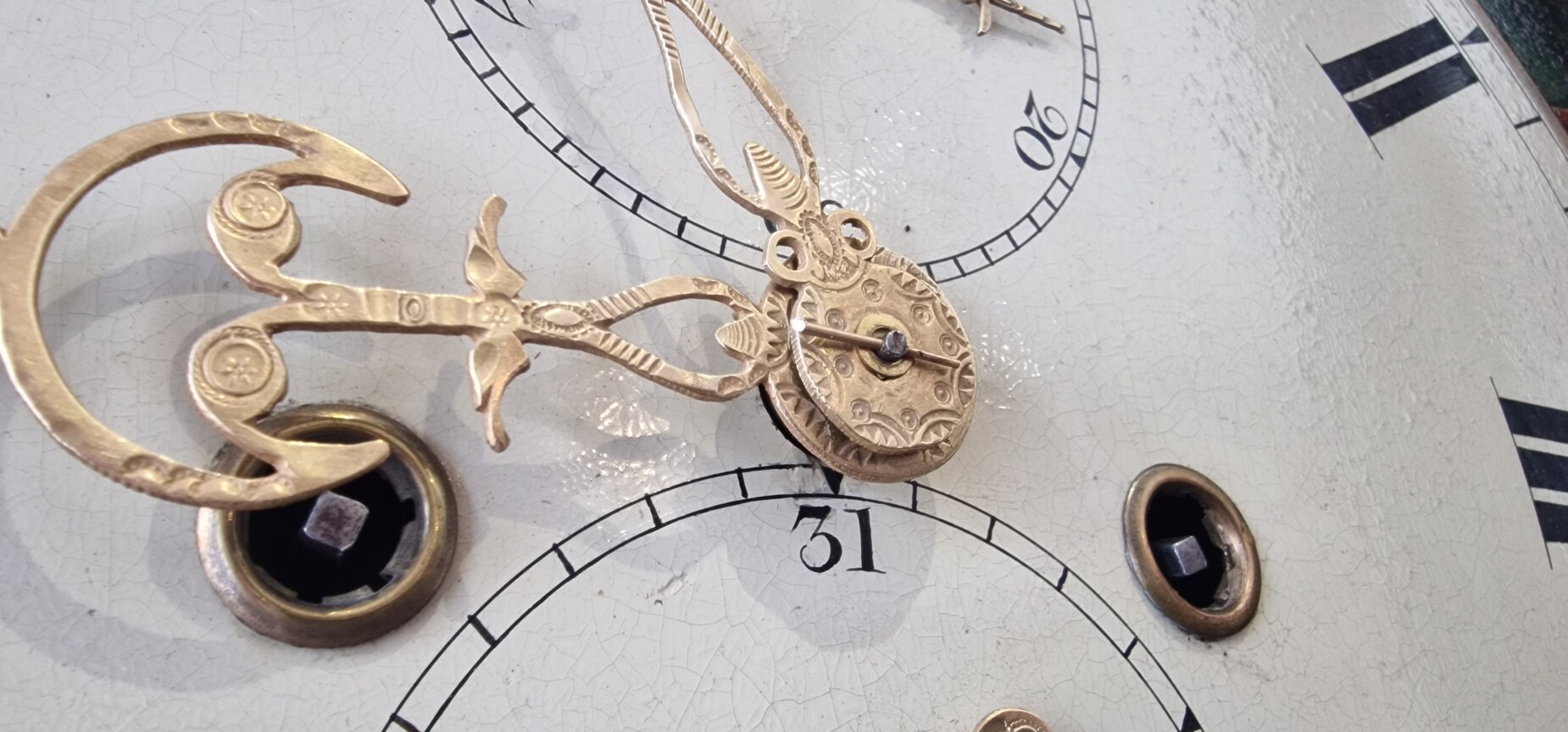
An eight-day clock is generally wound once a week. It usually has separate trains for timekeeping and striking, powered by two weights. Two winding holes can therefore often be seen on the dial.
Many eight-day clocks include a subsidiary seconds dial and a date indication. The clock may strike each hour on a bell, giving it an audible presence as well as a visual one.
Condition and quality matter more than the number of days between winding. A sound, original thirty-hour clock is usually preferable to a more elaborate eight-day example that has been heavily altered or poorly repaired.
The clockmaker’s name and town
A signed dial provides a starting point for researching a clock, but the inscription should be interpreted carefully.
The person named on the dial may have made the movement, assembled the clock from specialist components or retailed the completed piece. Clockmaking was a collaborative trade. Dial makers, movement makers, cabinetmakers and local retailers could all contribute to the finished clock.
The town name helps connect the clock with a particular community. A clock made or sold in a smaller Scottish town may be especially interesting because fewer examples survive.
Directories, trade records, census information and specialist reference books can sometimes establish when a named maker was active. This can help narrow the likely date of the clock, although the physical evidence should always agree with the documentary research.
A famous name is not essential. Many attractive and historically valuable clocks were produced by provincial makers whose surviving work is now comparatively scarce.
Cases, woods and regional character
The case was responsible for protecting the movement and supporting the long pendulum, but it was also an important piece of furniture.
Oak was widely used, particularly for country clocks. Mahogany became a fashionable choice for more imposing examples, sometimes enhanced with flame figuring, crossbanding or contrasting inlay. Pine and other secondary woods may be found within the construction even when the visible surfaces are more expensive.
Scottish cases can have strong architectural qualities. Hood columns, shaped pediments, pierced frets, panelled bases and bracket feet all contribute to the overall design.
The circular “drumhead” form became particularly associated with Scottish clockmaking during the nineteenth century. Its round dial and distinctive hood create a recognisable silhouette, although more conventional square and arched longcase forms continued to be produced as well.
Proportion is tremendously important. A well-designed case draws the eye naturally from the base, through the long trunk door and towards the painted dial.
Understanding originality
The originality of a longcase clock is rarely a simple question. These were working household objects, and many have been maintained for two centuries or more.
Lines, bushes and other wearing components may have been replaced as part of responsible maintenance. Such work does not automatically diminish a clock, particularly when it has been performed sympathetically.
More significant questions arise when a movement, dial and case have been brought together from different clocks. This is sometimes described as a “marriage”. Differences in fixing points, alterations inside the hood or a poor fit between the dial and case may provide evidence of such changes.
The dial signature must also be assessed carefully. Names have occasionally been strengthened, altered or added to make a clock appear more desirable.
A specialist examination can help distinguish normal historic maintenance from alterations that materially affect authenticity, interest or value.
Caring for an original painted dial
An aged dial should not be expected to look newly painted. Gentle discolouration, fine crazing and small areas of wear can form part of its character.
Heavy repainting may remove original details and flatten the appearance of the decoration. Cleaning a dial without the appropriate knowledge can be equally damaging, as apparently mild products may disturb fragile paint or lettering.
Restoration should therefore be approached conservatively. The objective is to stabilise and preserve the dial while respecting the surviving original finish.
The clock’s case deserves similar consideration. Aggressive stripping or modern varnish can erase the mellow surface developed over generations. Traditional waxing, localised repairs and carefully matched veneers are generally more appropriate than wholesale refinishing.
At Clockwise Antique Clocks, dial, case and movement work is considered in relation to the clock as a complete historical object. Necessary repairs can then be carried out using traditional techniques while retaining as much original character as possible.
What to examine before buying
Begin by looking at the complete clock rather than concentrating solely on the painted dial. The proportions should be convincing and the dial should sit naturally within the hood.
Check the following details:
- The clockmaker’s name and town on the dial.
- The condition and originality of the painted surface.
- Whether the dial, movement and case appear to belong together.
- The quality of the movement and any evidence of previous repairs.
- The presence of the correct weights, pendulum and winding key.
- Damage, lifting veneer or later alterations to the case.
- Whether any calendar, moonphase or automaton feature operates correctly.
- The clock’s service history and any available provenance.
A photograph can provide a useful first impression, but it cannot reveal every mechanical or structural issue. Whenever possible, seek advice from an experienced antique clock specialist.
Positioning a longcase clock in the home
A longcase clock must stand firmly and be correctly set up if it is to run reliably. Old floors and walls are seldom perfectly level, so the case may need careful adjustment after delivery.
The clock should be protected from strong direct sunlight, which may fade the painted dial and case. It is also sensible to avoid radiators, damp walls and locations subject to abrupt changes in temperature or humidity.
The case must be stable, the movement level and the pendulum free to swing. A clock that stops after being moved may simply be out of beat, but repeatedly pushing or bending components can turn a straightforward adjustment into an expensive repair.
Professional delivery and installation are particularly worthwhile for a tall or valuable clock. The movement, weights and pendulum should be removed before the case is transported and correctly refitted at its destination.
Restoration and regular maintenance
A longcase movement collects dust and its lubricants deteriorate with time. Adding more oil is not a substitute for proper servicing and can attract dirt or allow worn components to suffer further damage.
During a comprehensive overhaul, the movement is removed and dismantled so that each part can be inspected. The components are cleaned, worn pivots and pivot holes are corrected where necessary, and damaged parts are repaired or remade in a manner appropriate to the clock.
The movement is then reassembled, lubricated sparingly with suitable clock oil and tested over an extended period. Strike work, calendar mechanisms, moonphase displays and automata must all function together correctly.
Clockwise specialises in the restoration and repair of antique clocks. Our work can include movement restoration, dial conservation and traditional cabinet work, allowing the whole clock to be treated with a consistent respect for its age and integrity.
Why Scottish painted dial clocks remain so appealing
A Scottish painted dial longcase clock is more than a timekeeper. It is a piece of furniture, a mechanical instrument and a painted historical record.
Its movement demonstrates the practical skill of the clockmaker. Its case reflects regional cabinetmaking traditions. Its dial preserves the decorative tastes, stories and aspirations of the society for which it was made.
No two examples age in quite the same way. The softened colour of an original dial, the mellow surface of a mahogany case and the steady sound of an old movement give each clock an individual personality.
This combination of craftsmanship and character explains why Scottish painted dial clocks continue to appeal to experienced collectors and first-time antique clock buyers alike.
Buying or restoring a Scottish longcase clock
If you are considering purchasing a Scottish painted dial longcase clock, or already own one that requires attention, informed advice can make an enormous difference.
Clockwise Antique Clocks is a third-generation family business established in 1956. We specialise in longcase clocks and other fine antique timepieces, combining traditional horological skills with careful conservation.
Our restored antique clocks are thoroughly inspected and tested, with nationwide delivery and expert installation available. Restoration work can encompass the movement, painted dial and wooden case, according to the needs of the individual clock.
Explore the current collection of antique longcase clocks for sale, learn more about our antique clock restoration workshop or contact Clockwise Antique Clocks for friendly, straightforward advice.