
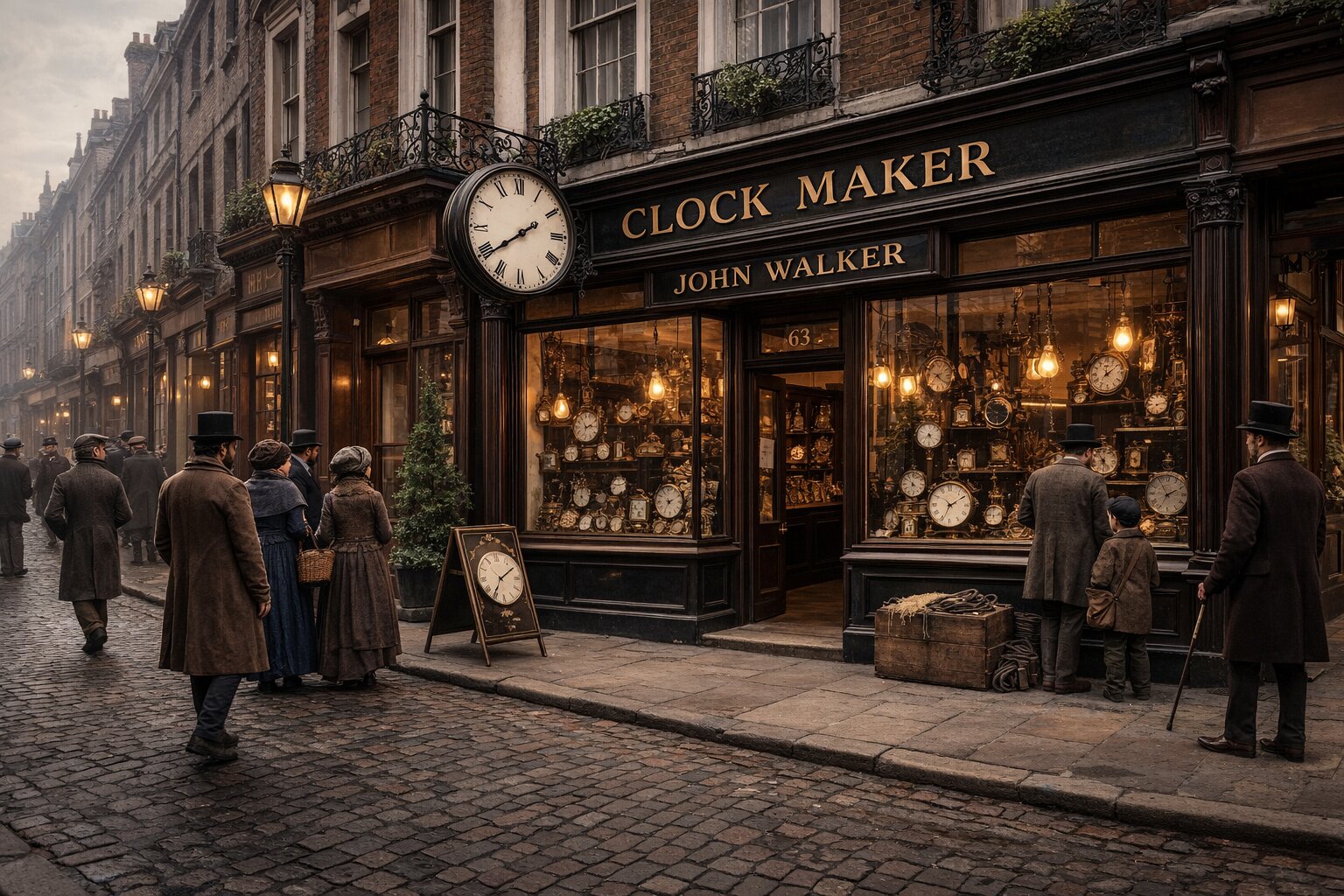
The Legacy of John Walker London Clockmaker 1830
The name John Walker holds a notable position within the story of British clockmaking, firmly tied to London at a time when the role of time itself was changing. What had once been a largely domestic concern was becoming something far more critical, driven by industry, transport, and coordination on a national scale. Walker’s business, established during the mid-19th century, arrived at exactly the right moment, aligning itself with the growing demand for accurate and dependable timekeeping as Britain’s railway network expanded rapidly across the country. This connection between craftsmanship and infrastructure would go on to shape both the identity of his work and the enduring reputation of the Walker name.
Beginning his operations in London around 1845, Walker traded from several respected locations including Cornhill, Regent Street, and later South Molton Street. He entered a market that was already saturated with talent, as London had long been regarded as the heart of precision horology. With a lineage of master clockmakers before him, competition was fierce, and standing out required more than just skill. Walker’s approach was to focus less on decorative pieces and instead specialise in reliable, purpose-built timekeeping designed for practical use in public and industrial environments.
Rather than producing clocks purely for private homes or display, Walker carved out a niche supplying instruments that served a wider function. This direction proved particularly significant as the Victorian railway system began to redefine how time was measured and managed. Before rail travel became widespread, local time varied slightly from town to town, based largely on the position of the sun. The railways, however, demanded uniformity. Without synchronised time, train schedules would fail, and safety would be compromised. Walker’s clocks became part of the solution, providing station clocks, precision watches for railway staff, and ongoing maintenance to ensure accuracy across the network.
This role placed considerable responsibility on the firm. These were not simply products being sold; they were tools relied upon daily by an entire transport system. Walker clocks were therefore built with durability and consistency in mind, capable of performing in environments that exposed them to dust, vibration, temperature changes, and near constant use. Over time, they earned a reputation for being dependable, and the signature “John Walker, London” became widely recognised on dials found in stations throughout Britain.
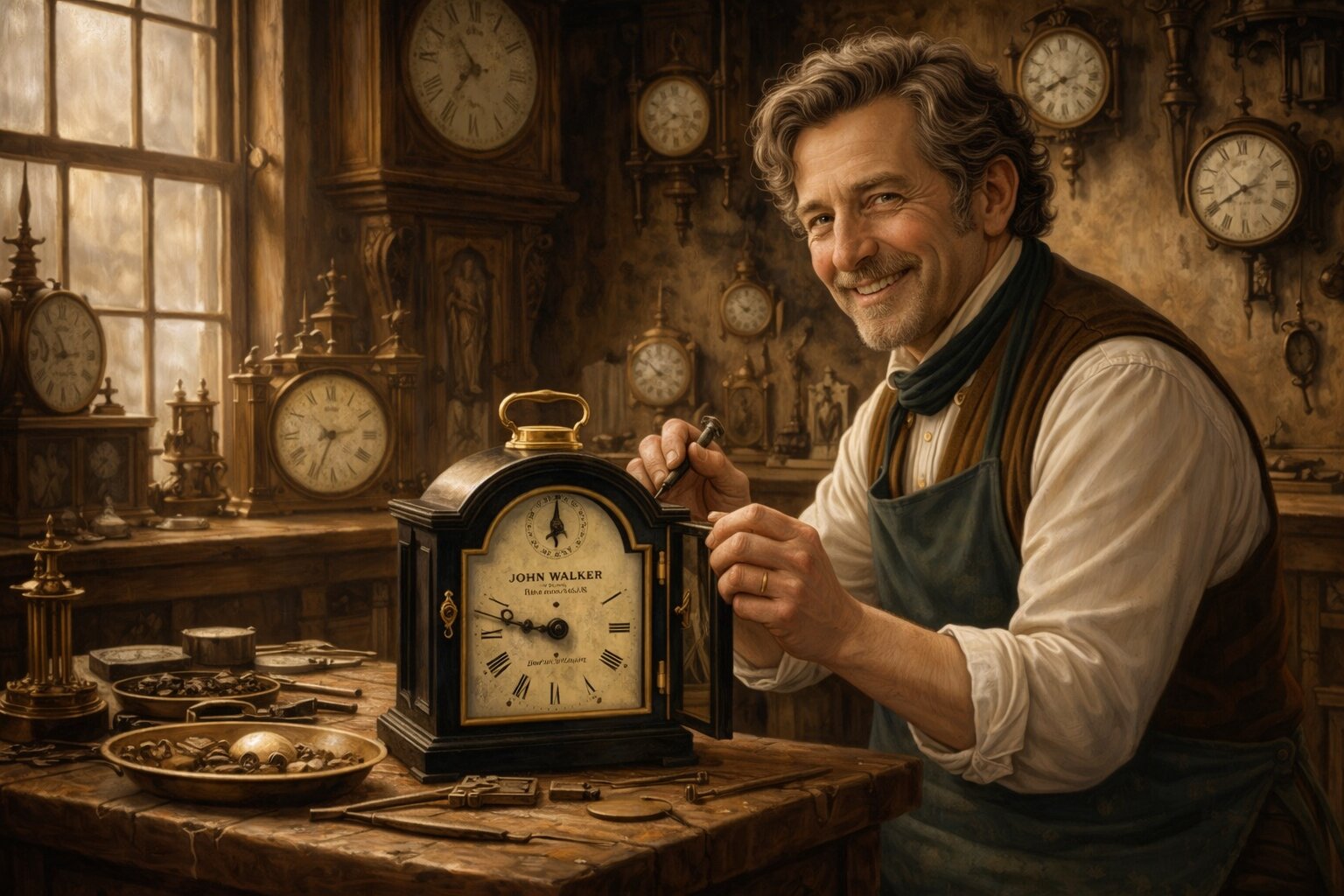
Visually, Walker clocks reflect a design philosophy centred on clarity and function. Their appearance is typically understated, with large, easy-to-read dials housed in solid mahogany cases that offer both strength and a traditional finish. Roman numerals were commonly used, providing a familiar and legible format, and in some cases, these were complemented by smaller red 24-hour markings to assist with operational timekeeping. The hands themselves were simple and purposeful, often shaped in a spade or baton style, ensuring they could be read quickly from a distance rather than admired for decorative detail.
Internally, the engineering followed the same practical mindset. Walker frequently utilised fusee-driven movements paired with recoil anchor escapements, a well-established system in high-quality English clockmaking. The fusee mechanism worked to regulate the force delivered by the mainspring, maintaining consistent power as it unwound and therefore improving accuracy. Many of these clocks were designed with eight-day movements, allowing them to run for a full week before requiring winding, which was particularly useful in public or commercial settings where convenience mattered.
Beyond large clocks, the company also produced a range of watches, including chronometers and what became known as railway guard watches. These timepieces had to meet strict standards, mirroring the same emphasis on precision and reliability found in Walker’s clocks. Historical advertisements reveal a broad offering, from practical silver watches to more refined gold versions, indicating that the business catered to both professional users and private customers.
As the years progressed, the Walker business transitioned from a traditional workshop into a more structured company, continuing its operations well into the 20th century. With the gradual modernisation of the railway system and the eventual introduction of electronic timekeeping, the need for mechanical railway clocks declined. Even so, the Walker name did not disappear. The firm remained connected to its roots through repair, servicing, and restoration work, preserving its legacy within the changing landscape of timekeeping.
What makes John Walker’s story particularly interesting is how closely it ties craftsmanship to the wider functioning of society. Unlike many clockmakers whose work is associated with luxury or artistic expression, Walker’s significance lies in practicality. His clocks were not just objects; they were part of a system that kept the country moving. In this sense, his work represents a shift in horology, moving away from personal ownership and towards a broader, shared need for accurate time.
Today, surviving Walker clocks are valued not only for their construction but for the history they carry. Each piece reflects a period when mechanical precision played a vital role in everyday life. The worn surfaces, aged materials, and steady ticking of the movement all serve as reminders of decades of continuous service, often spanning more than a century.
Ultimately, John Walker’s contribution was not about radical reinvention, but about refinement and application. He took established principles of clockmaking and applied them where they mattered most, meeting the demands of an evolving world. His work did more than measure the passing of time; it helped bring order to it.